

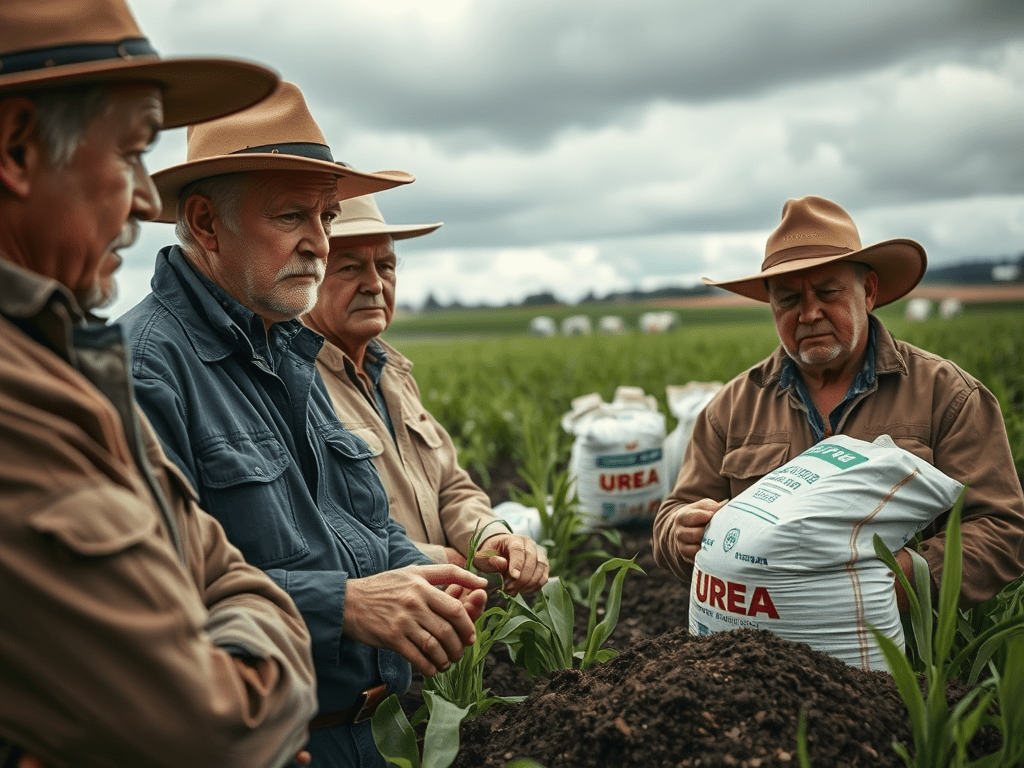
A Practical Guide for Australian Farmers
1. The Scale of the Problem
Australia’s fertiliser supply chain faces a severe and immediate threat. The country imports approximately 95% of its annual urea requirements — around 3.8 million tonnes per year. Approximately 69% of those imports historically came from the Middle East (Qatar, Saudi Arabia, the UAE, Oman and Bahrain), with shipments transiting through the Strait of Hormuz.
Escalating conflict in the Middle East has effectively stopped shipping through the Strait of Hormuz, cutting off the primary route for Gulf fertiliser exports to Australia. This could not have come at a worse time: the winter cropping window — when demand for urea and DAP peaks for pre-seeding and top-dressing of wheat, barley and canola — runs from April to June.
| ⚠ Critical Supply Facts Australia has no significant domestic urea production following the closure of the Gibson Island facility in Brisbane in 2022. The next major domestic facility — Perdaman’s Karratha plant — is not expected to come online until 2027. Urea prices are already above A$1,200/t and rising. Ammonium sulphate (AmSul), the most commonly cited short-term alternative, is 99% imported from China — creating its own supply risk. |
| Fertiliser Type | Import Dependency | Primary Source | Risk Level |
| Urea (granular) | 95% imported | Middle East / SE Asia | CRITICAL |
| Ammonium Sulphate | 99% imported | China | HIGH |
| DAP/MAP | ~85% imported | Middle East / Morocco | HIGH |
| Liquid nitrogen (Flexi-N) | Domestically produced | CSBP, Kwinana WA | LOW |
2. Immediate Actions — This Season
2.1 Secure Remaining Urea Supply Now
Do not wait. Prices will continue to rise and supply windows will narrow sharply as April approaches. Farmers who have not yet confirmed their urea supply for the winter season should contact their fertiliser supplier immediately. The government is actively pursuing alternative import sources from Southeast Asia and Oman, but the timeline is uncertain.
2.2 Switch to Locally Produced Liquid Nitrogen
CSBP has increased production of Flexi-N — its liquid fertiliser containing urea, ammonium and nitrate — by approximately 20% at its Kwinana Distribution Centre, with Geraldton and Esperance also scaling up. This is one of the only genuinely domestically manufactured nitrogen sources available at scale right now, particularly for WA farmers.
Incitec Pivot Fertilisers (operating under Dyno Nobel) also manufactures liquid fertiliser products locally and is worth contacting directly.
2.3 Reduce Rates and Use Precision Placement
With supply constrained, getting fertiliser directly into the root zone — banding rather than broadcasting — can reduce required application rates by 20–30% without a corresponding yield penalty. This single agronomic change can make a constrained supply last a full season.
2.4 Maximise Legume Rotations
Crops such as lupins, chickpeas, field peas and faba beans fix atmospheric nitrogen through rhizobium bacteria in their root nodules, effectively building a nitrogen bank in the soil for the following cereal crop. A well-managed legume break crop can contribute 50–150 kg N/ha to the following season — entirely free of imported inputs.
3. AGRIFIX Attapulgite — A Domestically Produced Force Multiplier
Hudson Marketing Pty Ltd, an Australian-owned company, mines and processes attapulgite clay (Fuller’s Earth) from Lake Nerramyne in Western Australia — the largest premium-grade attapulgite deposit in Australia and one of the largest globally, with an inferred resource of 23.4 million tonnes. The site is located 160 km from Geraldton Port, enabling efficient bulk shipment.
| Key Point: AGRIFIX Does Not Replace Nutrients — It Makes Nutrients Work Harder AGRIFIX 102 and 103 are particle-size graded attapulgite products designed primarily for use by fertiliser manufacturers and agronomists. They are not direct nitrogen, phosphorus or potassium sources. Their role is to dramatically improve how efficiently whatever fertiliser IS applied actually performs in Australian soils. |
3.1 How AGRIFIX 102 and 103 Help in a Supply Shortage
Fertiliser Carrier and Controlled-Release Extender
AGRIFIX products have high cation-exchange capacity and high nutrient-holding capacity, with consistent particle size distribution. Fertiliser manufacturers can blend attapulgite with a smaller quantity of urea or DAP to produce a slow-release granule — meaning the same amount of imported fertiliser goes significantly further per hectare. This is directly relevant when urea supply is constrained.
Nutrient Retention — Reducing Leaching Losses
On Australia’s sandy soils — particularly in WA — nitrogen leaches rapidly after rain before plant roots can take it up. By conditioning soil with AGRIFIX before or alongside a reduced fertiliser application, farmers retain more nitrogen per kilogram applied. The product’s natural adsorption properties bind nutrients in the root zone, reducing the leaching losses that have historically led to over-application.
Water Retention — Reducing Drought Stress
AGRIFIX is hydrophilic, absorbing water and slowly releasing it back into the soil during dry periods. AGRIFIX has been recommended by the WA Department of Primary Industries and Regional Development for use in containers at a rate of approximately 10% application by volume. Reducing drought stress directly reduces the nutrient demand spikes that force emergency top-dressing applications.
Suspension Fertiliser Stability
As liquid fertiliser products such as CSBP’s Flexi-N become more important during the current shortage, attapulgite becomes a key manufacturing ingredient. Attapulgite clay is commonly added to suspension fertilisers to improve storage stability, preventing crystal growth and settling. Domestic liquid fertiliser manufacturers can benefit directly from a local, secure supply of AGRIFIX.
Soil Conditioning for Long-Term Efficiency
As an active soil conditioner, AGRIFIX improves soil drainage and aeration in heavy soils, and improves water absorption and nutrient distribution in hydrophobic sandy soils — a chronic problem across large areas of WA, SA and southern NSW. Better soil structure means more efficient uptake of every nutrient applied.
| ⚠ Important Note for Certified Organic Farmers While attapulgite as a mineral appears on the Australian National Standard for Organic and Bio-Dynamic Product’s permitted materials list, this does NOT automatically mean AGRIFIX 102/103 as a commercial product is certified organic. Farmers on certified holdings should contact Hudson Marketing directly and verify with their certifying body (ACO, NASAA, or OFC) before use. |
3.2 Product Grades and Packaging
The 102 and 103 designations refer to different particle size distributions of the same attapulgite clay — finer vs. coarser granulation — which determines suitability for specific applications:
- Coarser grades — granular fertiliser carrier and controlled-release formulations
- Finer grades — suspension fertiliser stabiliser, soil conditioning, and wetting agent carrier
Available pack sizes: 25 kg paper bags, 10L tubs, 500 kg and 1,000 kg bulk bags. The bulk bag format makes AGRIFIX practical for broadacre grain farmers at scale.
4. Diatomaceous Earth — Protecting What You Have
Hudson’s Diatomaceous Earth (DE) is sourced from Western Australia and is composed primarily of silica derived from the fossilised remains of microscopic diatom organisms. While DE does not replace fertiliser nutrients, it plays an important complementary role in a constrained-input strategy.
4.1 Natural Grain Storage Pest Control
DE works as a natural mechanical pest control against soft-bodied insects including grain weevils, the primary pest threat to stored grain. In a season where fertiliser inputs are maximally valuable, protecting the grain produced from those inputs — without adding chemical costs — is critical. DE is non-toxic, leaves no chemical residue, and is effective against pyrethroid-resistant insect strains.
4.2 Silica Source for Plant Health
Silica strengthens plant cell walls, improves drought and disease resistance, and reduces overall crop stress — which in turn reduces the nutrient demand spikes that require emergency fertiliser applications. DE applied to the soil or as a foliar treatment contributes bioavailable silica to crops that benefit from it, including wheat, barley and rice.
4.3 Poultry and Livestock Applications
For mixed farming operations, DE has established applications in poultry bedding (reducing moisture and ammonia build-up) and as a natural pest deterrent in livestock environments. This is relevant to the broader fertiliser question because reducing purchased input costs in the livestock enterprise frees cash flow for purchasing fertiliser for cropping.
5. Biological and Organic Alternatives
Beyond AGRIFIX and DE, a range of fully domestic biological and organic nitrogen sources can substitute for or supplement synthetic imports.
5.1 Biological Inoculants
Nitrogen-fixing bacteria such as Azotobacter can capture atmospheric nitrogen, reducing dependence on synthetic urea applications. Phosphate-solubilising fungi make locked-up phosphorus available in Australian soils. Products featuring Rhizobium combat soil diseases, improve plant resilience, and contribute to stronger root systems.
Australian company Ecogrowth is a notable domestic supplier — an Australian-owned and operated business with production facilities, laboratories and industry experts, offering biologically activated granular and liquid fertilisers for over 25 years.
5.2 Compost, Manure and Organic Matter
Natural biological fertilisers derived from organic sources such as fish, seaweed and plant-based materials contain beneficial microorganisms that activate soil microbes, enhancing nutrient availability and overall soil health. Fish hydrolysate, produced in Australia, is a viable supplemental nitrogen source, especially in horticulture. For mixed farmers, maximising manure recycling back onto cropping country is also worth prioritising.
5.3 Enhanced Efficiency Fertilisers (EEFs)
The Grains Research and Development Corporation (GRDC) has initiated a A$17 million project aimed at maximising the potential of fertilisers in the grains industry, seeking to minimise the risk of nitrogen loss by aligning fertiliser supply more effectively with crop demand through enhanced efficiency fertilisers. EEFs help farmers get more from less fertiliser — critical when supply is tight.
6. The Longer-Term Domestic Supply Picture
Two major domestic production facilities are under development that will substantially reduce Australia’s import dependence — but neither is available for the 2026 winter season.
| Project | Location | Capacity | Expected Online |
| Perdaman Project Ceres | Karratha, WA | 2.3 million t/yr urea | 2027 |
| Woodside Beaumont New Ammonia | WA | 1.1 million t/yr | TBC |
| CSBP Flexi-N expansion | Kwinana, WA | +20% liquid N capacity | Now (2026) |
In the interim, the Federal Government is actively sourcing alternative import sources from Southeast Asia and Oman. However, farmers should not rely on these supply lines being confirmed before the April–June cropping window.
7. Priority Action Summary
The following actions are listed in order of urgency for the 2026 winter cropping season:
- URGENT: Secure any remaining urea supply immediately — prices are above A$1,200/t and rising.
- THIS WEEK: Contact CSBP about Flexi-N liquid nitrogen availability for your region.
- THIS WEEK: Contact Hudson Marketing about AGRIFIX 102/103 bulk pricing and trial rates to use as a fertiliser efficiency booster alongside reduced urea rates.
- BEFORE SEEDING: Review application method — switch to banding/precision placement to reduce required rates by 20–30%.
- SEASON PLANNING: Maximise legume break crops wherever rotations allow, targeting 50–150 kg N/ha biological nitrogen credit.
- SEASON PLANNING: Consider biological soil inoculants (Ecogrowth and others) to supplement reduced synthetic inputs.
- COMPLIANCE: For certified organic holders: verify any substitute input with your certifying body (ACO, NASAA, or OFC) before use.
8. Australian Supply Alternatives at a Glance
| Product / Input | Supplier | Location | Replaces / Reduces | Key Benefit |
| AGRIFIX 102/103 Attapulgite | Hudson Marketing | WA | Urea/DAP volume needed | Nutrient & water retention, fertiliser carrier |
| Diatomaceous Earth | Hudson Marketing | WA | Chemical grain storage pesticides | Natural grain pest control, silica source |
| Flexi-N Liquid Nitrogen | CSBP | Kwinana WA | Granular urea | Domestically manufactured nitrogen |
| Liquid fertilisers | Incitec/Dyno Nobel | Regional AUS | Granular urea | Locally blended, broad availability |
| Legume break crops | On-farm | All regions | Full N applications | Free biological N fixation |
| Biological inoculants | Ecogrowth & others | AUS-made | Synthetic N & P | Soil microbial activation |
| Compost / manure | On-farm / local | All regions | Partial N/P/K | Organic matter, soil carbon |
| Enhanced efficiency fertilisers | Various | Imported/local | Standard urea | Less N needed for same yield |
9. Key Contacts
| Organisation | Role | Website |
| Hudson Marketing Pty Ltd | AGRIFIX 102/103 attapulgite & diatomaceous earth | Email: [email protected] hudsonmarketing.com.au |
| CSBP | Flexi-N liquid nitrogen, WA | csbp.com.au |
| Incitec Pivot / Dyno Nobel | Liquid and granular fertilisers | incitecpivot.com.au |
| Ecogrowth | Biological inoculants and organic fertilisers | ecogrowth.com.au |
| GRDC | Enhanced efficiency fertiliser research | grdc.com.au |
| Australian Certified Organic (ACO) | Organic certification body | aco.net.au |
| NASAA | Organic certification body | nasaa.com.au |
| OFC (Organic Food Chain) | Organic certification body | organicfoodchain.com.au |
| The Strategic Opportunity in This Crisis The current disruption is painful, but it is also exposing a genuine long-term opportunity. Products like AGRIFIX attapulgite represent a domestically abundant, Australian-owned resource that has been underutilised precisely because cheap imported urea made fertiliser efficiency less important. That calculus has now changed permanently. The farmers who come through this season in the best shape will be those who combine reduced synthetic inputs with better soil management — using attapulgite to retain nutrients, biologicals to fix nitrogen, legumes to build soil capital, and precision application to eliminate waste. That is also, incidentally, a more resilient and profitable farming system for every season that follows. Email: [email protected] P: 02 9251 7177 |
 AUS Diatomaceous Earth & Attapulgite Clay Supplier
Leave a comment