

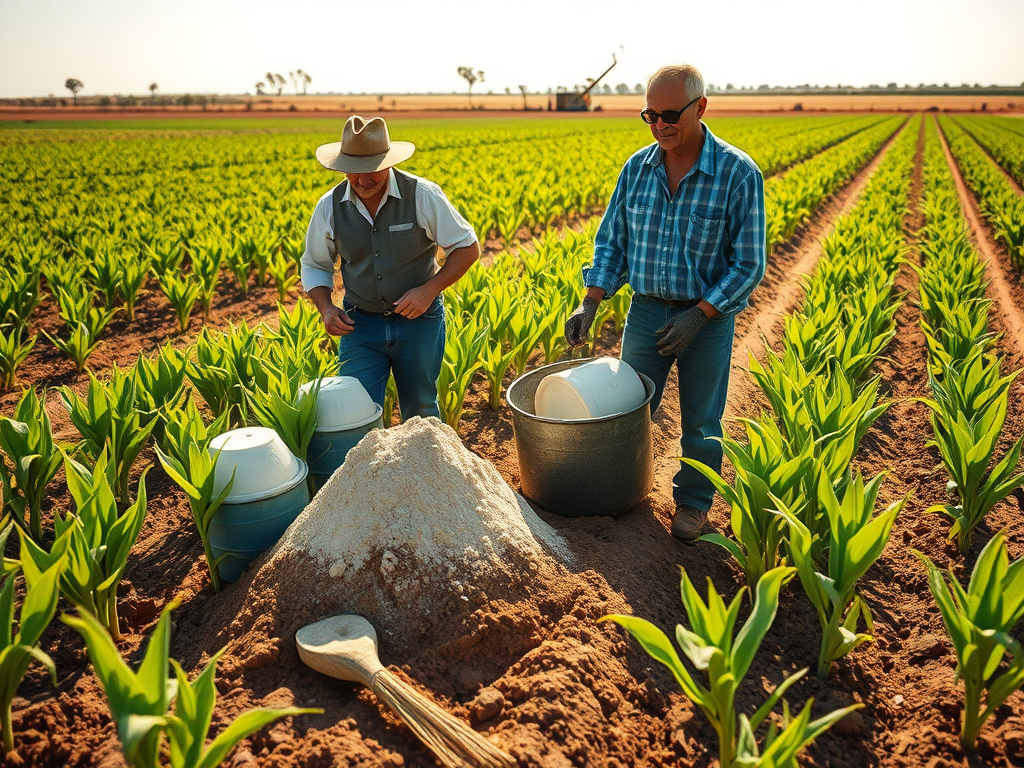
How attapulgite clay and diatomaceous earth from Geraldton, WA can substitute, stretch and protect your inputs this sowing season — starting this week.
10 things Australian farmers need to know right now
| # | Point | What it means for your farm |
| 1 | Fertiliser supply is in crisis now | The Strait of Hormuz closure has cut one third of global fertiliser trade. Australian urea stocks run out mid-April. Some retailers have already stopped taking orders. |
| 2 | Attapulgite clay stretches your nitrogen further | AgriFix attapulgite has high cation exchange capacity (CEC). It holds ammonium ions in the soil and releases them slowly to plant roots — so the urea you do apply works harder and leaches less. |
| 3 | You can use it this week — no new equipment | AgriFix 102 is a granular product. Blend it with urea, amsul, or MAP at any blending facility, or apply it through your air-seeder at sowing. No equipment modifications required. |
| 4 | It keeps moisture in the seed zone | Attapulgite retains water in the soil around the germinating seed — critical in WA sandplain, mallee, and coastal soils during a dry opening to the season. |
| 5 | It improves soil structure and root growth | Applied as a soil amendment, attapulgite increases pore space, reduces compaction, and supports deeper root penetration — improving plant vigour in the first weeks after sowing. |
| 6 | AgriFix 103 replaces imported pesticide carrier | Australian pesticide manufacturers currently import attapulgite carrier grade from Spain and the US. AgriFix 103 meets CIPAC MT 59 specification and is available domestically now. |
| 7 | Diatomaceous earth protects your stored grain | WA freshwater-origin diatomaceous earth (DE) kills grain storage insects physically — no chemical active, no residue, no resistance development. Mix with grain at storage. Available immediately. |
| 8 | Both minerals come from Western Australia | Processed at Narngulu, Geraldton and processed by Hudson Marketing Pty Ltd. AUD pricing. FOB Geraldton and Fremantle. No import risk. No currency exposure. |
| 9 | The reserve is large — supply is secure | Mineral supply security: Hudson Resources holds 24 million tonnes of attapulgite clay and 3.5 million tonnes of diatomaceous earth. Long-term supply security not subject to export restrictions or geopolitical disruption. |
| 10 | Samples and pricing available | Enquire: [email protected] Call (02) 9251 7177 |
What attapulgite clay does — property by property
| Property | How it works in soil | Benefit to your crop this season |
| High cation exchange capacity (CEC) | Adsorbs ammonium (NH4+) and potassium (K+) ions onto the clay surface; releases them progressively as plant roots take up nutrients | Nitrogen and potassium held in the root zone — less leaching, more value from every kilogram of fertiliser applied |
| Needle-like crystal microstructure | Extremely high surface area relative to weight — far greater than plate clays like kaolin or bentonite | Small application rate delivers disproportionate adsorption benefit; effective at low inclusion rates in blends |
| Natural colloidal stability | Disperses evenly through soil solution and water without settling or clumping | Uniform nutrient distribution through the soil profile; no hotspots; consistent establishment across the paddock |
| Soil water retention | Hygroscopic — holds water molecules within the crystal matrix and releases them to the root zone | Retains moisture around the germinating seed; reduces moisture stress during dry opening conditions |
| Soil structure improvement | Increases inter-aggregate pore space and soil aeration in the root zone | Reduces compaction risk; improves root penetration; supports early plant vigour in the critical first 3–4 weeks |
| Natural granule binder | Adhesive properties without synthetic agents — binds fertiliser granules mechanically | Improves structural integrity of blended fertilisers; reduces dust and product breakdown in the bag and at application |
| Inert, pH-neutral chemistry | Does not react with fertiliser actives, herbicides, fungicides, or seed treatments | Safe to blend with urea, ammonium sulphate, MAP, or any standard crop protection product |
| Freshwater-origin purity | Low swelling index; consistent particle size; low contaminant load | Reliable, batch-certified performance — not subject to the quality variation seen in some imported attapulgite grades |
What diatomaceous earth does — property by property
| Property | How it works | Benefit to your operation this season |
| Physical insecticide | Sharp amorphous silica particles abrade the waxy outer cuticle of insects, causing them to lose moisture and die | Kills weevils (Sitophilus spp.) and lesser grain borers (Rhyzopertha dominica) in stored grain — no chemicals required |
| Zero chemical active ingredient | Purely physical mode of action — no synthetic compound present | No MRL concerns; no chemical residue on grain; fully compatible with domestic and export market requirements |
| No resistance development | Insects cannot adapt biochemically to a physical desiccant | Effective on all pest populations regardless of what chemical insecticides have been used on your property historically |
| Freshwater-origin amorphous silica | Lower crystalline silica content than marine-origin DE; safer occupational health profile | Preferred grade for grain contact applications; lower dust hazard during handling and application |
| Anti-caking and flow improvement | Absorbs surface moisture; prevents grain and granule clumping during storage | Keeps stored grain and fertiliser blends flowing freely through augers and handling equipment |
| Livestock and poultry dual use | Physical contact desiccant effective against mites and lice on animals and in shed environments | Addresses pest management across both cropping and livestock enterprises from a single domestic input |
AgriFix 102, AgriFix 103 and Diatomaceous Earth — at a glance
| Product | Use | Specification | Availability |
| AgriFix 102 | Micro-granular fertiliser carrier; soil conditioner at sowing; granule binder for blended fertilisers | High CEC microgranular attapulgite; freshwater-origin; compatible with all standard fertiliser inputs | FOB Geraldton / Fremantle. Blend with urea, amsul, MAP. |
| AgriFix 103 | Agrochemical carrier for WDG and wettable powder pesticide formulation | CIPAC MT 59 particle-size specification; batch-certified; engineered for agchem carrier use | FOB Geraldton. |
| Diatomaceous Earth | Grain storage protectant; in-crop insect control; livestock pest management; feed anti-caking | Freshwater-origin amorphous silica; food-contact grade; zero chemical active ingredient | Available immediately. Apply directly to stored grain or as a dust. FOB Geraldton. |
What AgriFix and DE substitute or enhance this season
| What you cannot get or is too expensive | How AgriFix or DE helps | Realistic outcome |
| Full urea rate at normal price | AgriFix attapulgite clay has potential to improve nitrogen-use efficiency via CEC — holds nitrogen in the root zone and reduces leaching | Apply attapulgite with a reduced urea rate. Agronomic trials show CEC minerals can support comparable yields at 15–25% lower N rates in high-leaching soils |
| DAP/MAP phosphate starter | Attapulgite properties adsorbs phosphate ions and releases them progressively to roots — maximises the yield from any P you do apply | Not a phosphate replacement. But every kilogram of scarce phosphate works harder when applied with attapulgite |
| Imported pesticide carrier mineral | AgriFix 103 is a direct drop-in domestic substitute alternative for imported attapulgite carrier grades | Australian agrochemical manufacturers can remove import dependency on carrier mineral — available FOB Geraldton now |
| Imported chemical grain protectant | Diatomaceous earth kills grain storage insects physically — no chemical active, no residue, no supply chain risk | Available immediately from Western Australia. Protects stored grain through the season without chemical inputs or import exposure |
| Synthetic soil conditioner / water crystals | AgriFix attapulgite improves soil water retention naturally at sowing — applies through standard seeder equipment | Improves moisture retention in the seed zone from day one of sowing. No special application equipment required |
What to do this week
| When | Action | How |
| This week | Contact Hudson Marketing for samples and pricing | Enquire: [email protected] Call (02) 9251 7177. Request AgriFix 102 and/or AgriFix 103 samples and a commercial quote. |
| This week | Order diatomaceous earth for grain storage | If you have last season’s grain in storage, apply DE now. Order before seasonal demand peaks. Available immediately from Geraldton. |
| Before seeding | Blend AgriFix 102 with your fertiliser | Compatible with urea, ammonium sulphate, MAP, and compound blends. Mix at your local blending facility or on-farm. Standard equipment. |
| At seeding | Apply AgriFix as in-furrow soil amendment | Apply through standard air-seeder or combine equipment at seeding. Improves moisture retention and soil structure from day one. |
| At seeding | Discuss reduced urea rate with your agronomist | Potential for attapulgite clay application to improve nitrogen retention depending on application and context. |
| This season | Lock in a supply contract | The Strait of Hormuz disruption will persist for months. Lock in a domestic supply arrangement now to secure volume and pricing. |
| AgriFix 102 & AgriFix 103 — available from Geraldton, Western Australia Microgranular attapulgite clay processed by Hudson Marketing Pty Ltd at Narngulu, Geraldton WA. AUD pricing. No import dependency. FOB Geraldton and Fremantle. Diatomaceous earth also available. T: (02) 9251 7177 | E: [email protected] | Level 5, 52 Phillip Street, Sydney NSW 2000 |
The numbers you need to know: Urea up 26% since conflict began ($465 → $585/tonne globally). Australian domestic stocks: mid-April runout projected. Ammonium sulphate: 99% of Australian supply imported from China — now restricted. Phosphate prices forecast +50% if Strait of Hormuz remains closed. Australia’s diesel buffer: 34 days. At least one Australian retailer has suspended fertiliser orders.
What the Iran war means for your paddock
The following table shows the current supply situation for Australia’s key agricultural inputs as of March 2026:
| Fertiliser / input | % of AU supply from Gulf / imports | Current situation — March 2025 |
| Urea (nitrogen) | 64% from Gulf | Domestic stocks projected to run out mid-April. Prices up 26% since conflict began. At least one Australian retailer has suspended orders. |
| Ammonium sulphate | 99% from China | China has restricted exports. Domestic prices at A$480/t. Stocks critically low after a rush of demand from growers seeking urea alternatives. |
| DAP / MAP (phosphate) | High import reliance | Morocco and Middle East supply disrupted. Phosphate prices forecast to rise 50%+ if Strait of Hormuz remains closed. |
| Diesel / fuel | Imported crude | Australia has just 34 days of diesel buffer. Freight costs rising sharply as vessels reroute around Cape of Good Hope. |
| Potash | Canada, Belarus, Russia | Supply already constrained since 2022. No Gulf exposure, but compounding shortfall alongside urea and phosphate disruption. |
Sources: Argus Media, CSIS, Al Jazeera, Stock Journal, Australian Bureau of Statistics trade data.
The compounding effect is the critical issue. It is not just urea. It is urea and ammonium sulphate and phosphate and diesel — simultaneously, at the start of a sowing window that cannot be moved. This is not a situation where you can wait for prices to normalise. Sowing happens now.
What attapulgite clay is — and what it actually does in your soil
Attapulgite clay — also known as Palygorskite and Fuller’s Earth — is a naturally occurring magnesium aluminium silicate mineral mined from a 24-million-tonne reserve at Narngulu, near Geraldton in Western Australia. It has been used in agriculture globally for decades. What makes it directly relevant to the current input crisis is a set of physical and chemical properties that allow it to perform several of the functions your fertiliser inputs perform — or significantly enhance the efficiency of the fertiliser you do manage to source.
Attapulgite is not a fertiliser. It does not contain nitrogen, phosphorus, or potassium. But it changes what happens to the nitrogen, phosphorus, and potassium you apply — holding them in the root zone, releasing them progressively, reducing leaching loss, and improving the soil conditions in which roots grow and nutrient uptake occurs. In a season where you may be applying significantly less fertiliser than you planned, maximising the return from every kilogram you do apply is not optional — it is the difference between a viable crop and a marginal one.
Attapulgite clay: full property and benefit breakdown
| Property | What it means | Benefit to your crop — right now |
| High cation exchange capacity (CEC) | Holds positively charged nutrient ions (N, P, K) in the soil matrix | Fertiliser you do apply — even in reduced quantities — is held in the root zone longer and released progressively. Less leaching. More value per kilogram spent. |
| Needle-like crystal microstructure | Extremely high surface area relative to weight | Adsorbs water and nutrient ions across a very large contact area. A small application rate delivers disproportionate soil benefit. |
| Natural colloidal stability | Disperses uniformly in water and soil solution | Mixes evenly through soil profile or fertiliser blend — no hotspots, no uneven distribution. |
| Soil water retention | Holds moisture in sandy and loamy soils | In the WA grain belt, SA and Vic cropping soils, attapulgite in the seed zone retains moisture around the germinating seed — critical in a dry opening. |
| Soil structure improvement | Increases pore space and aeration | Reduces compaction risk in heavier soils, improves root penetration and early plant vigour — directly supporting establishment in the critical first weeks after sowing. |
| Granule binder — no synthetics needed | Natural adhesive properties | Attapulgite binds blended fertiliser granules without synthetic agents. If you are blending your own inputs this season, it reduces formulation cost. |
| Inert, pH-neutral chemistry | Does not react with fertiliser actives or soil chemistry | Safe to blend with urea, amsul, MAP, or any remaining fertiliser stock. Does not interfere with herbicide or fungicide seed treatments. |
| Freshwater-origin purity (AgriFix, WA) | Low swelling index, consistent particle size | Reliable, batch-certified performance. Not subject to the quality variation seen in some imported clays. |
What the science says about nitrogen efficiency with attapulgite
The mechanism is well established in soil science. Attapulgite’s high cation exchange capacity (CEC) means positively charged ammonium ions (NH4+) — the form in which nitrogen is held in soil after urea application — adsorb onto the clay surface and are released gradually as plant roots create a demand. This is the same principle behind slow-release nitrogen products that sell at a premium. Attapulgite delivers a comparable nitrogen retention effect at the cost of a mineral carrier, not a coated urea product.
In practical terms: if you are applying 50 kg/ha of urea but attapulgite improves nitrogen retention in your soil by 20 per cent, the effective fertiliser value of that 50 kg is closer to 60 kg. In a season where you may only be able to source 80 per cent of your normal urea requirement, attapulgite can close much of that gap.
| Agronomist note on rate reduction: Independent evaluation by agrochemical manufacturers has confirmed AgriFix attapulgite clay meets the particle size and performance specifications required for professional agchem carrier use. Consult your agronomist before reducing fertiliser rates. In sandy soils with high leaching risk (typical WA sandplain and coastal soils), the nitrogen retention benefit of attapulgite is most pronounced. In heavier clay soils, the soil structure and water retention benefits are typically the primary value driver. |
What diatomaceous earth is — and what it does for your grain and your crop
Diatomaceous earth (DE) is a sedimentary rock made from the fossilised remains of diatoms — microscopic aquatic organisms with silica-based cell walls. When milled to a powder, the sharp silica fragments act as a physical insecticide: they abrade the waxy outer layer (cuticle) of insects on contact, causing the insect to lose moisture and die. There is no chemical active ingredient. There is no mode of action that insects can develop resistance to. There is no re-entry interval. There is no chemical residue on treated grain.
Hudson’s Geraldton deposit is freshwater-origin diatomaceous earth — the grade preferred for food-contact and grain storage applications because of its lower crystalline silica content compared to marine-origin DE.
Diatomaceous earth: full property and benefit breakdown
| Property | What it means | Benefit to your operation — right now |
| Physical (non-chemical) insecticide | Sharp silica particles abrade insect cuticle, causing dehydration and death | No chemical active. No resistance development. No re-entry interval. No MRL concern for export markets. Works immediately on application. |
| Freshwater-origin silica (WA grade) | Lower crystalline silica content than marine-origin DE | Better safety profile for handling. Preferred grade for food contact and grain storage applications. |
| Zero chemical residue | No synthetic active ingredient | Grain treated with DE meets all domestic and export market requirements. Ideal for growers supplying premium or organic-accredited buyers. |
| No resistance mechanism | Purely physical mode of action | Insects cannot develop resistance to a physical desiccant. Effective regardless of what chemical insecticides have been used historically on your farm. |
| Anti-caking / flow agent | Prevents clumping in stored grain and fertiliser blends | Keeps stored grain flowing freely. Can be used in fertiliser blending operations to improve granule flowability. |
| Livestock and poultry dual use | Effective mite and lice treatment in sheds and yards | For mixed farming operations, DE addresses both grain storage and livestock pest management from a single domestic input. |
Why DE matters specifically in the current crisis
With diesel at record prices and freight costs elevated, every kilometre of unnecessary truck movement costs more than it did twelve months ago. Every drum of imported chemical grain protectant that comes from Europe or the United States has those costs embedded in its price. Diatomaceous earth from Geraldton, WA travels a fraction of the distance to reach Australian farm storages — and it does the same job.
More critically: in a season where you may be storing grain for longer than usual — waiting for prices to recover as supply chains normalise — protecting that stored grain from weevil and lesser grain borer damage is not a cost you can afford to skip. A grain storage infestation in a season of record input costs, with export markets sensitive to MRL compliance, would compound an already difficult year severely.
What attapulgite and diatomaceous earth replace — and what they do not
Attapulgite clay and diatomaceous earth are not nitrogen. They are not phosphate. They are not a complete substitute for the fertiliser program you planned for this season. You still need to source whatever nitrogen and phosphate you can, from whatever supply exists.
What they do is fill specific, defined gaps in your input program — and they fill those gaps with a product that is available right now, from Western Australia, at AUD pricing with no import risk. The table below maps the specific substitution case for each:
| What you cannot get / is too expensive | How AgriFix / DE helps | Realistic expectation |
| Full urea rate at normal price | AgriFix attapulgite clay increases nitrogen-use efficiency via CEC — holds N in root zone, reduces leaching loss | Apply attapulgite with a reduced urea rate. Independent trials show CEC minerals can maintain comparable yield outcomes at 15–25% lower N application rates when soil moisture and timing are managed. |
| DAP / MAP phosphate starter fertiliser | Attapulgite enhances phosphate availability by adsorbing P ions and releasing them progressively to roots | Not a phosphate replacement, but maximises the yield from any phosphate you do apply. Critical when stocks are short. |
| Imported synthetic pesticide carrier | AgriFix 103 is a direct drop-in carrier for WDG and wettable powder formulations — domestically available now | For manufacturers and co-ops blending their own crop protection products, AgriFix 103 removes import dependency on Spanish or US carrier mineral. |
| Imported chemical grain protectant | Diatomaceous earth (DE) is a proven grain storage protectant — physical, not chemical | Protects stored grain from weevils and lesser grain borers without chemical residue. Available from Geraldton WA. Can be applied immediately. |
| Synthetic soil conditioner / water crystals | AgriFix attapulgite clay improves soil water retention naturally — particularly in sandy WA and SA soils | Applied at sowing as a granular soil amendment or blended with fertiliser. Improves moisture retention around the seed zone from day one. |
AgriFix 102 and AgriFix 103 — what to order and when
Hudson Marketing produces two microgranular attapulgite clay grades under the AgriFix brand from the Hudson Resources Ltd mineral reserve at Narngulu, Geraldton:
AgriFix 102 — Fertiliser carrier, soil conditioner, and granule binder. This is the grade relevant to growers applying attapulgite directly to paddocks at sowing as a soil amendment, and to fertiliser blenders incorporating it into compound or blended NPK products. High production volume available. Can be blended with urea, amsul, MAP, and compound fertilisers at your local blending facility or on-farm.
AgriFix 103 — Agrochemical carrier grade, engineered to CIPAC MT 59 particle-size specification for WDG (water-dispersible granule) and wettable powder (WP) pesticide formulation. Relevant to Australian pesticide manufacturers and regional agrochemical blending operations that currently source carrier-grade attapulgite from Spain or the United States. Domestically available, batch-certified, AUD-priced.
an action plan for sowing season 2026
The sowing window does not wait. Here is a practical sequence of actions for growers, agronomists, and farm input suppliers to take immediately:
| Timeframe | Action | Detail |
| This week | Contact Hudson Marketing for samples and pricing | Call (02) 9251 7177 or email [email protected] Request AgriFix 102 (fertiliser / soil conditioner) and/or AgriFix 103 (agchem carrier). Samples dispatched from Narngulu, Geraldton. |
| This week | Order diatomaceous earth for grain storage | If you have last season’s grain in storage or are planning to store this season’s crop, DE can be applied immediately. Order now before demand peaks. |
| Before seeding | Blend AgriFix 102 with your fertiliser | AgriFix 102 is compatible with urea, amsul, MAP, and compound blends. Mix at your local blending facility or on-farm. No special equipment required. |
| At seeding | Apply AgriFix as in-furrow soil amendment | Granular attapulgite can be applied through standard air-seeder or combine equipment at seeding. No modifications required. |
| At seeding | Discuss reduced urea rate with your agronomist | With AgriFix improving nitrogen retention, discuss whether a 15–20% reduction in urea rate is feasible given your soil type, rainfall zone, and crop. This stretches limited urea stocks further. |
| Ongoing | Lock in a supply contract | With the Strait of Hormuz disruption likely to persist for months, lock in a domestic supply arrangement now. Hudson Marketing offers volume pricing and contracted supply for the season. |
The broader case: why Australian farmers need a domestic mineral strategy
The Iran war did not create Australia’s agricultural input vulnerability — it exposed it. Australia has been without domestic urea production since Dyno Nobel closed its Gibson Island facility in 2022. It imports 99 per cent of its ammonium sulphate from China. It has 34 days of diesel buffer. These are not the supply chain metrics of a sovereign agricultural nation.
Western Australia holds 24 million tonnes of proven attapulgite clay reserve and 3.5 million tonnes of diatomaceous earth — minerals with direct, validated applications across soil conditioning, fertiliser enhancement, agrochemical carrier, and natural pest management. These reserves have existed for decades. The processing infrastructure is in place at Narngulu, Geraldton, close to major ports.
The question Australian agriculture needs to answer is not whether these minerals work — they do, and they are used at scale globally. The question is why Australian growers and manufacturers are still shipping the equivalent from Spain and the Middle East when a domestic source is available.
In a normal year, the answer might involve incremental cost comparisons and established supply relationships. In March 2026, with urea at $585 a tonne and climbing, diesel buffers at 34 days, and the Strait of Hormuz closed to commercial shipping, the answer is simple: use what you can get locally, now.
| A note from the author: This advisory has been prepared by Hudson Marketing Pty Ltd, the commercial supplier of AgriFix attapulgite clay and diatomaceous earth produced from Hudson Resources Ltd deposit reserves in Western Australia. The supply situation data cited in this document draws on publicly available reporting from Argus Media, CSIS, Al Jazeera, the Stock Journal, and the Australian Bureau of Statistics, current as of March 2026. Farmers should consult their agronomist before making changes to fertiliser rates or programs. |
| AgriFix 102 & AgriFix 103 — available now from Geraldton, Western Australia Attapulgite clay mined by Hudson Resources Ltd. Microgranular attapulgite clay processed and supplied by Hudson Marketing Pty Ltd. AUD pricing. No import dependency. FOB Geraldton and Fremantle. Technical samples available immediately. Diatomaceous earth also available for grain storage and pest management applications. T: (02) 9251 7177 | E: [email protected] | Level 5, 52 Phillip Street, Sydney NSW 2000 |
 AUS Diatomaceous Earth & Attapulgite Clay Supplier
Leave a comment