

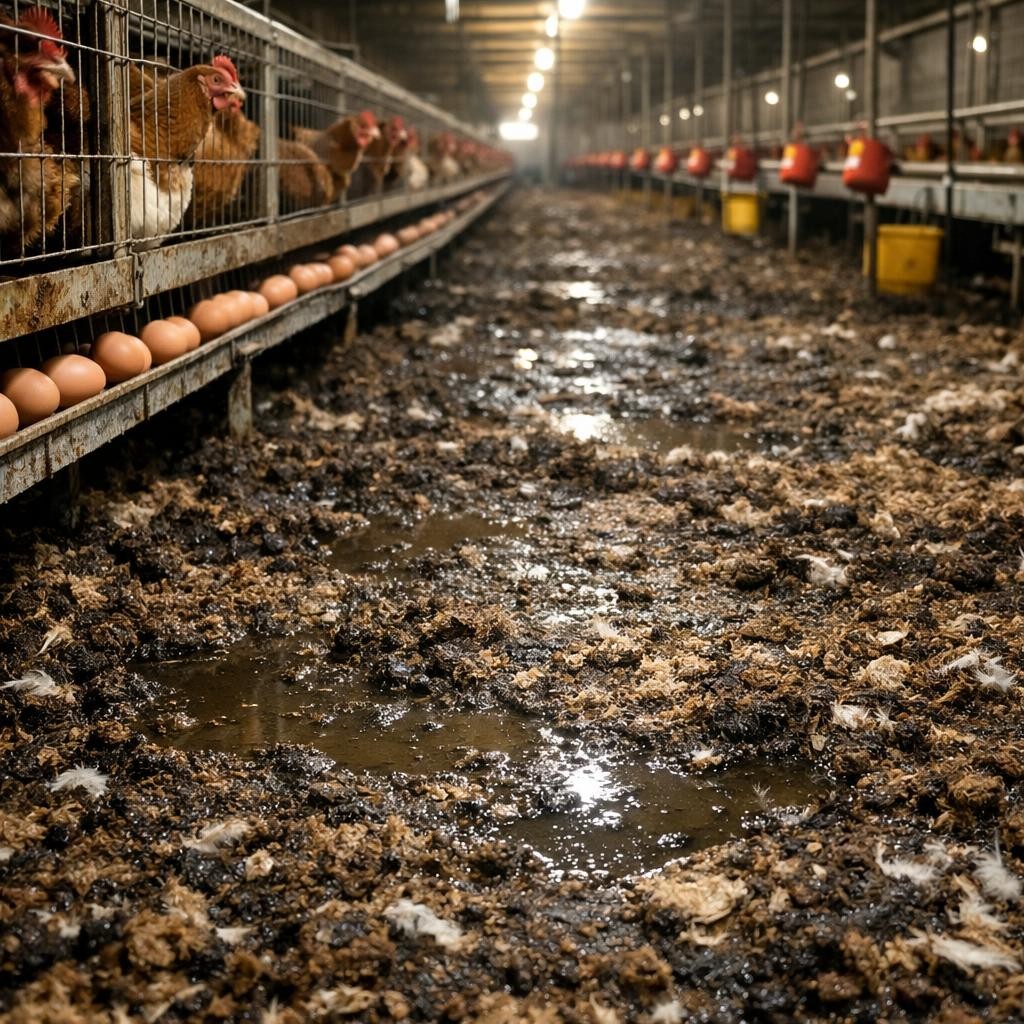
Executive Summary: Keep Your Birds Healthy, Your Shed Dry, and Your Profits Up
Wet litter is one of the most costly and under-managed problems in commercial poultry production. Footpad dermatitis, high ammonia levels, reduced feed conversion, carcass downgrades, and disease susceptibility all eat directly into flock profitability. Yet many growers still rely on imported chemical treatments — sodium bisulfate-based PLT (Jones-Hamilton, USA) or alum — which carry volatile pricing and supply risks.
ChickenKoop Refresh — a proprietary blend of Western Australian attapulgite clay and freshwater diatomaceous earth — delivers a locally sourced, natural solution. By physically absorbing moisture and trapping ammonia, it keeps litter dry and friable, protects bird welfare, and improves production outcomes — all without chemical inputs. Safe to use with birds present, fully RSPCA-compatible, and adaptable for both conventional and organic systems, it’s the Australian alternative growers can rely on.
This white paper presents the science, the economics, and the practical case for incorporating ChickenKoop Refresh into Australian poultry litter management. The numbers are clear:
| Impact Area | Untreated Wet Litter | With ChickenKoop Refresh |
| Ammonia at 50 ppm | Body weight down 17%; FCR worsens | Ammonia suppressed via moisture removal |
| Footpad Dermatitis | ~50% of paws condemned or downgraded | FPD reduced up to 40% with dry litter |
| Feed Conversion | FCR worsens by up to 10 pts at 50 ppm NH₃ | Improved FCR = less feed cost per kg meat |
| Egg production | Reduced output, albumen quality drops | Stable production in clean, low-NH₃ air |
| Worker health | Chronic lung & eye irritation above 25 ppm | Safer shed environment, more time on-farm |
| Supply security | PLT = USD-priced import from Ohio, USA | Western Australia-mined, domestically supplied, AUD priced |
The Problem: Wet Litter and Its True Cost
Poultry litter accumulates moisture from manure, water spillage, condensation, and high stocking density. Once litter moisture rises above 30–35%, a cascade of biological processes accelerates — bacterial decomposition of uric acid increases, ammonia volatilisation increases sharply, and the physical condition of the litter deteriorates. The consequences compound with every day of the flock cycle.
2.1 Footpad Dermatitis: The Visible Cost of Wet Litter
Footpad dermatitis (FPD) is the most directly measurable financial consequence of wet litter. It is caused by prolonged contact between a bird’s footpad and moist, ammonia-laden litter. The skin softens, the keratin layer breaks down, and lesions form — often progressing to secondary bacterial infection.
| Research across 63 million processed broilers found FPD severity was positively correlated with carcass condemnation rate and negatively correlated with live weight and leg meat yield. Controlling FPD is directly linked to fewer condemnations and better yields. (PMC / Kagoshima Prefecture study) |
The economics of FPD are significant:
- Chicken paws are the third most economically important part of the chicken — after breast and wings — with global export value exceeding USD $280 million per year.
- Approximately 99% of downgraded or condemned paws are the result of FPD lesions.
- The US poultry industry alone loses an estimated USD $250–300 million annually from FPD-related product loss.
- Management interventions that control litter moisture have demonstrated FPD reductions of up to 40%. (University of Georgia / CAES Research)
- Beyond paw value, FPD lesions allow pathogenic bacteria to enter the bloodstream, causing systemic infection, internal organ damage, and carcass rejection at the processing plant.
| FPD Severity | Commercial Consequence | Scale of Impact |
| Mild (Score 1) | Paw downgraded for domestic market | Revenue reduction per bird |
| Moderate (Score 2) | Borderline export quality, reduced value | Lost export premium |
| Severe (Score 3) | Paw condemned, zero value | Direct product loss |
| Systemic infection | Full carcass condemnation at slaughter | Maximum loss — entire bird value |
2.2 Ammonia: The Invisible Profit Thief
Ammonia (NH₃) is generated from the microbial decomposition of uric acid in litter. The rate of volatilisation is directly proportional to litter moisture content and pH. Reducing moisture is therefore the most effective upstream intervention for controlling ammonia — and ChickenKoop Refresh’s primary mechanism of action.
| Survey data from 300+ broiler houses showed only 37% had ammonia levels at or below the 25 ppm safety threshold. Fifty-three percent of houses were above 50 ppm — none of which had been treated with any litter amendment. (Jones-Hamilton Ag / Air Quality Survey) |
The recommended maximum ammonia concentration in poultry houses is 25 ppm. The consequences of exceeding this threshold are well-documented and substantial:
| NH₃ Level | Effect on Broilers | Effect on Birds’ Bodies | Financial Consequence |
| < 10 ppm | Ideal — no adverse effects | Normal | Best FCR and growth rates |
| 10–25 ppm | Minor performance drag begins | Mild respiratory irritation | Marginal FCR loss |
| 25 ppm | Body weight down 2% | Eye and tracheal damage begins; immune suppression | Measurable FCR penalty |
| 50 ppm | Body weight down 17% | Cilia damage, respiratory disease susceptibility rises sharply | Significant profit loss per flock |
| 75 ppm | Body weight down 21% | Severe respiratory, eye lesions, blindness, death | Major production failure |
Sources: Miles et al. (body weight decline data); Wang et al. (3-week-old broilers at 52 ppm showed 5.3% body weight improvement and 2.6% better feed:gain when ammonia was removed); PLT Research, Jones-Hamilton Ag.
Even at low concentrations, the FCR impact compounds across the flock cycle. With feed representing 60–70% of total production cost, a worsened FCR driven by ammonia exposure represents one of the most direct levers on shed profitability.
2.3 Ammonia and Egg Production
The impact of ammonia extends beyond meat production:
- Laying hens chronically exposed to ammonia above 25 ppm experience reduced egg production, lower egg weight, and deterioration of albumen quality (height, pH, condensation). (Multiple peer-reviewed studies, PMC)
- Early pullet exposure to 78 ppm ammonia delayed time to 50% production and reduced the total number of egg-producing days — a lasting consequence of poor air quality during rearing.
- High ammonia at 200 ppm over 17 days caused a statistically significant drop in egg production percentage and hen body weight. (PubMed, 1982)
2.4 Farmer Health: The Human Cost
Poultry workers experience chronic exposure to ammonia at levels that frequently exceed human occupational health standards — often without realising it, because habituation to the smell occurs quickly.
- The European occupational exposure limit is 20 ppm over 8 hours; levels in many broiler sheds routinely exceed 50 ppm.
- Human exposure to 12 ppm has been linked to significant pulmonary function decrements in poultry workers — well below what is typically present.
- High NH₃ is a corrosive substance to the eyes, skin, and respiratory tract — causing irritation, throat burning, lung illness, and in severe cases, blindness.
- A less-observed consequence: workers spend less time in a bad-smelling, eye-burning shed. Less time with birds means welfare problems go undetected longer — compounding health and production losses.
| Reducing ammonia in the shed is not just about the birds. It protects the farmer, reduces sick days, and keeps management attention where it should be: on the flock. |
The Science: Why Attapulgite Clay and Diatomaceous Earth Work
3.1 Attapulgite Clay (Fuller’s Earth / Palygorskite)
Attapulgite clay has a unique needle-like, three-dimensional crystalline structure that creates an exceptionally high surface area with microscopic channels throughout the particle. Unlike swelling clays such as bentonite (which can compact and reduce air circulation), attapulgite retains its structure under pressure and in moist conditions.
Key properties for poultry litter management:
- High Cation Exchange Capacity (CEC): binds ammonia ions (NH₄⁺) directly to the clay surface, physically trapping them rather than converting them chemically.
- Physical adsorption: volatile organic compounds, odour molecules, and moisture are bound onto the vast mineral surface area without any chemical reaction.
- Non-swelling: litter remains friable and loose, preserving the aerobic conditions that slow bacterial decomposition and ammonia production.
- Thermally stable: effective across the full temperature range encountered in Australian broiler sheds, including summer evaporative cooling conditions.
- Chemically inert and non-toxic: no pH manipulation, no acid salts, no bird or handler risk. Safe for application with birds present.
3.2 Diatomaceous Earth (Diatomite / DE)
Diatomaceous earth is composed of the fossilised frustules (silica shells) of microscopic freshwater algae called diatoms. The ChickenKoop Refresh blend uses freshwater DE from the Badgingarra deposit in Western Australia — a deposit prized for its high purity, high porosity, and strong absorptive capacity.
Key properties:
- Extremely high porosity: each frustule is a finely patterned, porous silica microstructure. Billions of these create a material with enormous moisture uptake capacity.
- Rapid absorption: DE absorbs moisture rapidly into its pore network, immobilising fluids and preventing them from remaining on the litter surface where ammonia volatilises.
- Physical desiccation: DE desiccates the litter surface through capillary action and adsorption, maintaining the dry, friable condition that is the primary defence against FPD.
- Natural pest deterrent: DE’s sharp silica edges physically damage the exoskeletons of mites, lice, and other soft-bodied insects, providing an incidental pest-reduction benefit in the shed.
- 80–90% amorphous silica: the freshwater (amorphous) form is suitable for agricultural and poultry use; it is not the crystalline (calcined) form used in pool filters, which is harmful.
3.3 The Synergy of the Blend
ChickenKoop Refresh combines both minerals in a single application. The blend is synergistic because each mineral addresses a different dimension of the moisture-ammonia problem:
| Function | Attapulgite Clay | Diatomaceous Earth | Combined Benefit |
| Moisture absorption | Moderate — adsorbs surface moisture | High — rapid uptake into pore network | Dual-mechanism moisture control |
| Ammonia binding | High — CEC traps NH₄⁺ ions directly | Low — indirect via moisture reduction | Reduces both source and volatilisation |
| Litter structure | Maintains friability, non-swelling | Lightweight, low bulk density | Stays loose, aerobic, easy to turn |
| Pest control | Limited | High — mechanical desiccation of insects | Added mite/lice reduction |
| Odour control | Strong — binds VOCs on surface area | Moderate — via moisture | Broad-spectrum odour reduction |
ChickenKoop Refresh vs PLT (Jones-Hamilton): A Complementary Relationship
PLT (Poultry Litter Treatment) by Jones-Hamilton Co. of the United States is the world’s leading litter amendment. It is based on sodium bisulfate (NaHSO₄) — an acid salt that works by lowering litter pH below 7.0, converting volatile ammonia gas (NH₃) into stable ammonium (NH₄⁺) that cannot volatilise. It is effective, well-researched, and widely used in American poultry production.
The following comparison is intended to be honest and useful — not adversarial. ChickenKoop Refresh and PLT address the same problem through fundamentally different mechanisms, which means they are as much complementary tools as they are alternatives.
| Criterion | PLT (Jones-Hamilton) | ChickenKoop Refresh |
| Active ingredient | Sodium bisulfate (NaHSO₄) — chemical acid salt | Attapulgite clay + diatomaceous earth — natural minerals |
| Mechanism | Chemical: acidifies litter pH, converts NH₃ → NH₄⁺ | Physical: absorbs moisture, adsorbs NH₄⁺ via CEC, binds VOCs |
| Moisture control | Indirect — by suppressing bacterial activity at low pH | Direct — absorbs and adsorbs moisture from litter |
| Application timing | Pre-placement; mid-flock re-application possible | Pre-placement and during grow-out; safe with birds |
| Bird safety | Non-hazardous; causes irritant ‘cloud’ if birds present when applying to high-ammonia litter | Completely safe at point of application with birds present |
| RSPCA / Organic compatibility | Generally compatible; some organic programs restrict chemical additives | Fully compatible with all welfare schemes including organic |
| Country of origin | Made in USA — imported, USD-priced, subject to shipping lead times | Made in Western Australia — domestically sourced, AUD-priced |
| Supply chain risk | Exposed to USD/AUD exchange rate, shipping disruptions, import logistics | No import dependency; secure domestic supply from WA mining leases |
| Environmental profile | Breaks down to sodium and sulfate — benign but synthetic | 100% natural mineral — biodegradable, no synthetic chemistry |
| Regulatory requirement | Imported chemical — subject to import documentation | Mined mineral — minimal regulatory burden |
| Pest control benefit | None | Mechanical insect control (mites, lice) via DE component |
| Application method | Spreader (granular) | Spreader or hand broadcast (powder/granular) |
4.1 When to Use Each — or Both
The ideal use case for ChickenKoop Refresh depends on the grower’s situation:
- Standalone replacement: For free-range, organic, or RSPCA-accredited operations where chemical inputs are restricted or discouraged, ChickenKoop Refresh provides all the primary benefits (moisture control, ammonia reduction, odour) without any chemical compromise.
- Complementary use: In conventional sheds currently using PLT, ChickenKoop Refresh can be applied between PLT applications to extend moisture control — particularly during high-humidity summer months or in wet-zone areas of the shed (around drinker lines). This reduces total PLT usage and import exposure while extending efficacy.
- Risk buffer: During periods of PLT unavailability or price spikes (exchange rate movements, shipping delays), ChickenKoop Refresh provides a domestically available fallback that can be scaled immediately from WA reserves.
| A grower who uses ChickenKoop Refresh alongside PLT is not replacing a proven product — they are building supply resilience and adding a natural moisture-control layer that PLT does not provide. |
The Economic Case: What Wet Litter Costs You and What You Save
The following estimates are based on a representative 40,000-bird broiler shed, running 6 flocks per year, with an average live weight of 2.5 kg and a market value of approximately AUD $4.50/kg live weight equivalent. Figures are illustrative order-of-magnitude estimates based on published research; individual farm results will vary.
5.1 The Cost of Unmanaged Ammonia: FCR Impact
| Scenario | NH₃ Level | Body Weight Impact | FCR Impact | Estimated Annual Cost (40,000 birds) |
| Optimal shed | < 10 ppm | None | Baseline FCR ~1.70 | Baseline |
| Moderate NH₃ | 25 ppm | -2% live weight | FCR worsens ~5 pts | ~AUD $18,000/yr lost revenue |
| High NH₃ (common) | 50 ppm | -17% live weight | FCR worsens ~10 pts | ~AUD $150,000/yr lost revenue |
| Severe NH₃ | 75 ppm | -21% live weight | Major FCR penalty | ~AUD $185,000+ yr lost revenue |
Note: body weight declines from Miles et al.; FCR impact from PLT research data (Jones-Hamilton Ag); cost calculations based on 6 flocks × 40,000 birds × 2.5 kg live weight × AUD $4.50/kg indicative value.
5.2 The Cost of Footpad Dermatitis: Paw Revenue Loss
The Australian broiler industry increasingly exports chicken paws to Asian markets, where they command premium prices. FPD is the dominant reason paws are downgraded or condemned.
| Metric | Value | Source |
| FPD-related paw condemnation | ~50% of paws in untreated wet litter sheds | University of Georgia CAES |
| Paws condemned from FPD lesions | ~99% of all condemned paws | University of Georgia CAES |
| Litter moisture management reduction of FPD | Up to 40% | University of Georgia CAES |
| Export value of quality paws | AUD $0.80–1.50 per pair (indicative) | Industry estimate |
| Revenue at risk (40,000 birds, 50% FPD rate) | AUD $16,000–30,000 per flock | Illustrative |
| Annual paw revenue at risk (6 flocks) | AUD $96,000–$180,000 | Illustrative estimate |
5.3 Disease Reduction: Reduced Medication and Mortality Costs
Wet litter and elevated ammonia create conditions that increase susceptibility to:
- Respiratory diseases (E. coli, Newcastle disease, IB): ammonia compromises the mucociliary escalator that clears pathogens from the respiratory tract.
- Coccidiosis and clostridiosis: wet conditions are ideal for oocyst survival and sporulation.
- Systemic bacterial infections from FPD lesions: bacteria entering the bloodstream from footpad wounds cause internal organ condemnations.
While quantifying medication savings per farm is highly variable, studies estimate clostridiosis and coccidiosis alone cause a 15% reduction in FCR when present — reinforcing the value of litter dryness as a primary biosecurity measure.
5.4 Ventilation Cost Savings
A critical and often overlooked cost of ammonia is ventilation. When ammonia rises, growers increase fan speed to flush the gas — a costly energy response that also stresses birds in winter with cold air ingress. PLT’s own research notes that treating litter allows growers to ventilate for relative humidity rather than for ammonia — a fundamentally more efficient shed management regime. ChickenKoop Refresh provides the same benefit through moisture removal, keeping ammonia from forming in the first place.
| Estimated annual energy savings from reduced compensatory ventilation: AUD $3,000–$8,000 per shed. (Indicative, based on Jones-Hamilton Ag ventilation studies adapted for Australian energy costs) |
5.5 Cost of ChickenKoop Refresh vs Total Value Protected
| Metric | Estimated Value | |
| Cost | ChickenKoop Refresh application cost per flock (40,000-bird shed) | AUD $800–$2,000 (indicative, subject to rate and shed size) |
| Value Protected #1 | FCR improvement (ammonia from 50 to <25 ppm) | AUD $25,000–$150,000 per year |
| Value Protected #2 | FPD reduction (40%) — paw recovery | AUD $38,000–$72,000 per year |
| Value Protected #3 | Reduced disease-related mortality and medication | AUD $5,000–$15,000 per year |
| Value Protected #4 | Energy savings from lower ventilation demand | AUD $3,000–$8,000 per year |
| Total Value Protected | Annual return on natural litter management investment | AUD $70,000–$245,000 per year |
These figures illustrate the order of magnitude of value at stake. Actual results depend on baseline shed conditions, flock performance, application rate, and market prices. An independent trial is the recommended path to farm-specific validation.
Supply Security: The Case for a Domestic Mineral
The COVID-19 pandemic exposed the fragility of agricultural input supply chains globally. Shipping containers became scarce, freight costs quadrupled, and products that growers had taken for granted became difficult to source. The poultry industry was not immune. As the Australian chicken meat industry continues to grow — with gross value of production estimated at AUD $3.9 billion and climbing — the risk of input disruption deserves serious management attention.
6.1 The PLT Import Dependency Problem
PLT is manufactured by Jones-Hamilton Co. in Ohio, USA. Every kilogram used on Australian farms must be:
- Produced in the United States
- Containerised and shipped across the Pacific (typically 30–45 day transit)
- Cleared through Australian customs and biosecurity
- Distributed through an Australian importer/distributor network
- Priced in USD, then converted — exposing growers to exchange rate fluctuation
Any disruption along this chain — shipping bottlenecks, USD/AUD movements, port strikes, import regulatory changes — results in either a price spike or a supply gap during the critical pre-placement window when litter treatment cannot be delayed.
6.2 ChickenKoop Refresh: A Sovereign Supply
The attapulgite clay and diatomaceous earth used in ChickenKoop Refresh are mined from leases in Western Australia holding approximately 24 million tonnes of attapulgite clay and 3.5 million tonnes of diatomaceous earth — enough to supply Australian poultry operations for generations.
| Supply Factor | PLT (Jones-Hamilton) | ChickenKoop Refresh |
| Country of manufacture | USA | Australia (Western Australia) |
| Currency exposure | USD — exchange rate risk every order | AUD — no currency risk |
| Lead time | 30–45+ days ocean freight | Days — domestic road freight |
| Reserve security | Subject to US production capacity | 24M tonne attapulgite + 3.5M tonne DE — WA leases |
| Regulatory risk | Subject to import documentation | Domestic mining — no import barriers |
| Price stability | Volatile — USD and freight costs | Stable — AUD, domestic freight |
| Environmental transport footprint | High — transoceanic shipping | Low — domestic road freight |
| Every tonne of ChickenKoop Refresh used is a tonne that does not need to cross an ocean. For Australian growers, that is not just a feel-good story — it is a genuine risk management decision. |
Why Natural Matters: The Non-Chemical Advantage
Consumer demand for transparency in food production is not a passing trend. Supermarket retailers — Woolworths, Coles, and their private-label chicken partners — are under increasing pressure to provide provenance and welfare assurances. RSPCA accreditation is now near-universal in the Australian commercial sector, and free-range certifications are growing. In this environment, the inputs used in production matter beyond their technical performance.
7.1 Compatibility with Every Production System
| Production System | PLT Compatibility | ChickenKoop Refresh Compatibility |
| Conventional broiler (RSPCA) | Compatible | Fully compatible |
| Free-range (FREPA certified) | Generally compatible | Fully compatible |
| Organic / NAE (No Antibiotics Ever) | May be restricted in some programs | Fully compatible — no chemical inputs |
| Broiler breeders | Compatible | Fully compatible |
| Commercial layers | Limited use in deep litter systems | Suitable for all litter-based systems |
7.2 The Consumer Confidence Dividend
The shift toward clean-label, naturally produced chicken is accelerating. Hazeldene’s Bare Bird, Baiada’s Slow Hills, and the growth of the organic sector all reflect a market moving toward production methods that consumers can understand and trust. A shed managed with natural minerals rather than imported chemical acid salts is a more defensible story at every level of the supply chain.
This is not a marginal concern. In the EU, broiler welfare labelling already includes environmental data. Australia is unlikely to be far behind. Growers who establish natural litter management practices now are building credentials that will differentiate them in contract negotiations with integrators in the years ahead.
7.3 Worker Safety: No Chemical Handling Risk
PLT, while classified as non-hazardous, requires careful handling — particularly during application, where the product can create an irritating ‘cloud’ if applied to litter with high existing ammonia levels (the ammonia reacts at the point of application). Application with birds present requires care.
ChickenKoop Refresh contains no acid salts and no synthetic chemistry. Application with birds present is completely safe. There is no specialist chemical handling requirement, no PPE beyond basic dust management, and no risk of ammonia cloud generation from the product itself.
Practical Application Guide
8.1 Recommended Application Rates
| Application Type | Rate | Timing | Notes |
| Pre-placement (standard) | 500–1,000 g/m² | 24–48 hrs before chick placement | Spread evenly; rake lightly into top layer |
| Pre-placement (wet litter carry-over) | 1,000–1,500 g/m² | 48 hrs before placement | Higher rate for reused litter |
| Mid-flock maintenance | 250–500 g/m² | Week 2–3, as needed | Focus on wet spots around drinker lines |
| Wet zone spot treatment | 500 g/m² targeted | As conditions require | Apply to visible wet patches immediately |
| Complementary use with PLT | 250–500 g/m² ChickenKoop Refresh | Between PLT applications | Extends efficacy; reduces total PLT volume |
Application rates are indicative. Growers should calibrate based on shed conditions, season, stocking density, and litter moisture monitoring. No maximum application rate has been established — the product is non-toxic and will not harm birds or litter quality at elevated rates.
8.2 Available Pack Sizes
- 10L retail tubs — suitable for small sheds, hobby farms, and trial use
- 500 kg bulka bags — commercial growers and integrators (recommended)
- 1,000 kg bulka bags — large-scale operations and multi-shed farms
- Custom pallet quantities available for wholesale and stockist supply
8.3 What to Measure
To quantify the benefit of ChickenKoop Refresh, growers should track the following metrics each flock:
- Litter moisture % — before application, at week 2, and at cleanout
- Ammonia ppm — measured at bird height at multiple points in the shed
- FPD score at processing — request data from the processing plant for each flock
- Body weight at each weigh day — compare to previous unmanaged flock
- FCR at settlement — the single most direct indicator of shed performance
- Mortality rate — elevated in high-ammonia environments
About ChickenKoop Refresh and the Minerals Behind It
9.1 Western Australian Origin — Badgingarra and Beyond
The diatomaceous earth in ChickenKoop Refresh is sourced from the Badgingarra deposit in Western Australia’s mid-west — a lacustrine (freshwater lake) deposit prized for its high purity, young geological age (limiting silica recrystallisation that reduces porosity), and strong absorptive performance. The attapulgite clay is sourced from WA mining leases holding 24 million tonnes of proven reserves.
Both minerals are mined under full environmental regulatory compliance in Western Australia, processed and blended, and distributed across Australia and internationally. The supply is sovereign, the volumes are substantial, and the quality is consistent.
9.2 Hudson Resources: The Source
ChickenKoop Refresh is produced using raw ore from Hudson Resources Ltd, an Australian company established in 1969 with extensive WA mining leases. Hudson Resources holds 8 mining leases with proven reserves of both attapulgite clay and diatomaceous earth, supplying into pet care, agriculture, poultry, jet fuel filtration, pharmaceutical, and aquaculture markets globally.
9.3 Who ChickenKoop Refresh is Designed For
- Commercial broiler contract growers — all flock sizes, all production systems
- Broiler breeder farms — where litter condition has a direct impact on egg quality and settability
- Commercial egg layers using deep litter or cage-free systems
- Turkey growers — where FPD rates are typically higher than in broilers
- Free-range and organic producers — where chemical treatment options are limited
- Integrator technical teams — as a recommended or endorsed litter management input
Next Steps: Trial, Evidence, and Partnership
10.1 The Trial Offer
We understand that growers make decisions based on results, not brochures. ChickenKoop Refresh is available for farm-scale trials. A trial involves:
- One treated shed vs. one untreated or PLT-only shed in the same flock
- Free or subsidised product supply for the trial flock
- A simple litter moisture and ammonia tracking sheet
- Processing plant FPD score comparison at batch close
- Full results review and cost-benefit analysis provided to the grower
10.2 Who to Contact
Whether you are a contract grower, an integrator technical manager, a rural produce retailer, or an industry consultant, we welcome your enquiry:
| Contact | Details |
| Website | www.chickenkoop.com.au |
| [email protected] | |
| Supply (wholesale / bulk) | [email protected] |
| Technical enquiries | [email protected] |
| Wet litter is costing Australian broiler growers tens of thousands — sometimes hundreds of thousands — of dollars per year. ChickenKoop Refresh is a natural, domestically sourced solution that can be trialled this flock. |
References: Miles et al. (ammonia and body weight); Wang et al. (FCR at 52 ppm NH₃); Jones-Hamilton Ag air quality survey data; University of Georgia CAES (FPD and moisture management); PMC / Kagoshima Prefecture (63M bird FPD study); Orffa (NH₃ effects on broiler production); PubMed (laying hen egg production at high NH₃); EU/Norwegian OEL standards for farm workers; AgriFutures / ACMF (Australian industry data); PMC Air Quality / Alternative Housing Systems (laying hen NH₃); Hudson Resources Ltd (reserve data, WA mining leases).
 AUS Diatomaceous Earth & Attapulgite Clay Supplier
Leave a comment